


Abstract
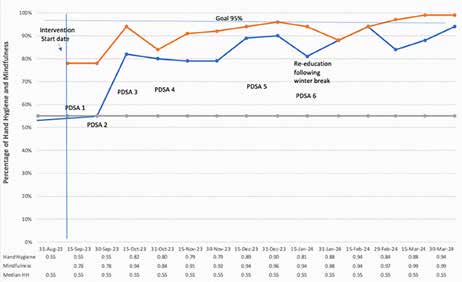 Background: Burnout (BO) and healthcare-associated infections (HAIs) are both linked to high-cost burdens in the United States. The literature supports that BO reduction programs addressing chronic stress can reduce the retraining costs of nurses and healthcare workers. Mindfulness has been shown in the literature to improve compassion satisfaction, focus, creativity, and work environment and decrease work-related stress. Improving compassion satisfaction in nurses and healthcare teams can prevent compassion fatigue, which can cause symptoms of irritability, and can lead to burnout. Proper hand hygiene can reduce the high costs associated with healthcare-associated infections (HAIs). Local problem: Baseline data at a metropolitan university-based clinic showed a moderate level of secondary traumatic stress (STS), BO and compassion satisfaction (CS), and hand hygiene compliance of 55%. Methods and Interventions: An interprofessional care team N = 31 in a quality improvement project practiced box breathing with positive self-messaging during routine hand hygiene for 20 seconds. Following an education intervention on mindfulness and hand hygiene for staff, measurement of mindfulness and hand hygiene participation was collected weekly and reported bi-monthly for six months. Direct observation and self-report checklists were utilized with attention to quality and rates of hand hygiene and a pause for a deep breath for mindfulness. Self-reported levels of BO, STS, and CS were evaluated pre- and post-intervention with Professional Quality of Life (ProQOL 5) surveys. Jean Watson’s Theory of Human Caring was chosen as the theoretical framework. This framework was chosen because of the focus on self-care and care for others. Self-care can be effective in increasing CS and preventing BO Results: Improvement was identified in CS from 4 to 5 (high) on the ProQOL 5 (1-5 Likert scale) p = .017, n = 8. There was no change in BO or STS from 3 (moderate) on the Likert scale. A process measure demonstrated a strong willingness of the providers and staff to implement box breathing during hand hygiene throughout their day. A goal of mindfulness participation of 95% was achieved and hand hygiene compliance improved by 30-45% without negatively impacting clinic patient volumes. Implications: Mindfulness during hand hygiene is a cost-effective, feasible way to improve BO, STS, and CS and hand hygiene for interdisciplinary care teams. This intervention can be replicated in similar clinical settings but may realize different results. Box breathing with positive self-messaging during hand hygiene can be incorporated along with other self-care techniques into pre-licensure nursing education to prepare nursing students to better manage job-related stress, enhance job satisfaction, and prevent BO.














1 Comment. Leave new
This is a great idea to increase a focus on self-care. Perhaps adding a reminder on hand washing stations would really reinforce this positive behavior.